
Sibilance. Use of a de-esser and an acceleration limiter to deal with it, and the consequences.
Recording vocals with a closely positioned microphone often contains an excessive amount of high frequencies (HF). Such a signal can be recorded and reproduced with high quality on studio equipment, but after it is transferred to a lacquer disc, the original clean “sss” sound can turn into an unpleasant blurred hiss (“shhh”).
A high level of sibilants (hissing and whistling sounds such as “sss”, “shhh”, “zzz”), as well as other HF-rich elements (for example, hi-hats), are unacceptable for the vinyl format. They can provoke intermodulation effects, which lead to sound distortion and instability of the stereo image. Therefore, during pre-mastering it is strongly recommended to control the level of these frequencies using de-essers and other dynamic processing tools.
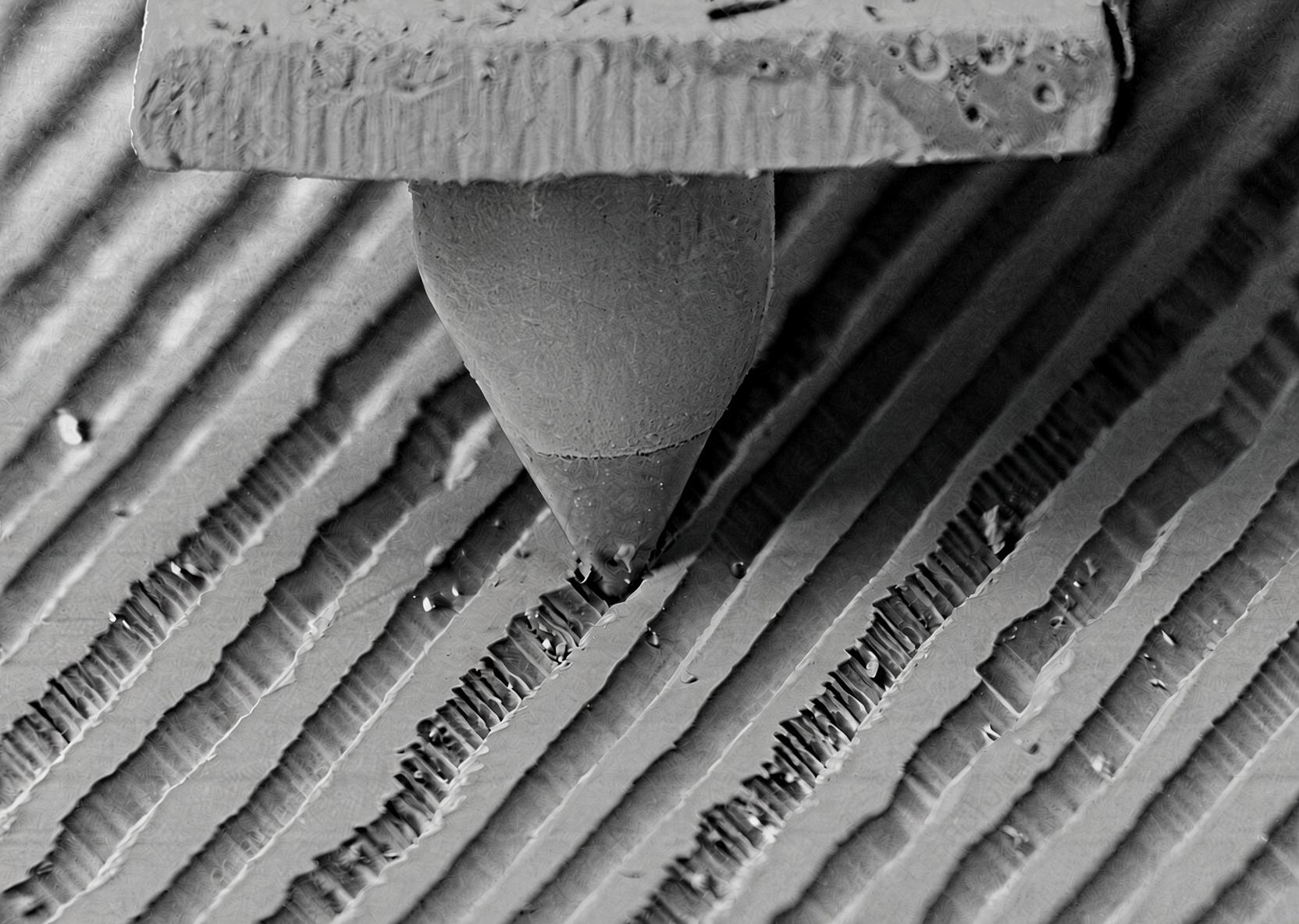
In the photo we see an example of what sibilants cut into a record look like. Looking at the stylus in the groove, it is clearly visible that it is unable to reproduce this fine modulation.
De-essers and high-frequency acceleration limiters
This peculiarity of vinyl production presents the mastering engineer with a difficult task. It is necessary to provide adaptive, dynamic timbre control that suppresses high frequencies only when their energy exceeds a critical threshold. A device that performs this function is called a de-esser.
Most vinyl cutting systems are equipped with similar processing (for example, the Neumann HK66 module in the VG66 rack). Moreover, Neumann developed a special calibrated high-frequency acceleration limiter (the BSB-74 unit) for its later models of vinyl cutting lathes. This device works on the same principle as a classic de-esser.
The BSB-74 acceleration limiter was calibrated to limit current to 1.4 A in the range above 4 kHz, which limits any acceleration to 8150 m/s².
With such a calibrated acceleration limit of 8150 m/s² (830 G), the maximum modulation of the audio groove is limited to a frequency of 4.6 kHz, and the maximum velocity is 28 cm/s. Neumann made an impeccable choice, because this limit guarantees that a stylus with an effective tip radius of 25 μm will be able to reproduce without obstruction any modulation of the groove limited in this way at all recording radii.
Is this where the secret of “analog magic” lies?
A considerable amount of indirect evidence suggests that the use of acceleration limiters and de-essers explains the difference in sound quality between LP and CD releases of the same musical material. Listeners clearly prefer the version with limited high frequencies (HF).
Of course, one can argue that the significant velocity and acceleration limitations imposed by the physical nature of the vinyl record are precisely what provide the “warmth” of sound that is so often mentioned. Uncompressed PCM audio files (even at the standard sampling rate of 44.1 kHz) impose no restrictions on high frequencies. Therefore, to provide the same HF quality as a CD (44.1 kHz), a record would have to support a maximum groove velocity of 525 cm/s (which is ten times higher than the standard 50.9 cm/s). And an uncompressed audio file at 96 kHz has an equivalent acceleration limit of 3.5 million G — at such a figure a typical cartridge would need a tracking force of 0.5 kg just to keep the stylus in the groove!