
Use of an elliptical equaliser (EE), aggressive high-pass and low-pass filters, and mid-side processing (M/S) to control — that is, to limit — the low end, the high end and stereo (out-of-phase) information.
The cutting engineer’s job is to maximise the groove modulations that store the data in the mechanical memory of the medium. The useful signal should sit as far above the noise of the groove itself as possible, without risking damage to the lacquer master, the cutting head or the playback stylus. It is a tightrope, and signals with certain characteristics make the work much harder.
Among the main problem factors:
- Excessive low frequencies. They cause too much lateral (horizontal) modulation. If the audio is too loud or too bass-heavy, groove pitch becomes critical. The pitch-control computer reaches the limit of the drive’s power, and the cutter breaks through the wall of the neighbouring groove — overcutting.
- Excessive high frequencies. To cut high-frequency motion onto a spinning disc, cutting-head acceleration can reach 3000G. Sibilants (the hissing sounds “s”, “sh”, “z”) and other high-frequency elements (hi-hats, for example) are especially critical. An “sss” that is clean on tape or in a digital recording can become a dirty “shhh” on vinyl and can cause intermodulation. That leads to distortion and the collapse of the stereo image. Such frequencies must be tightly controlled with de-essers and limiters at the premastering stage.
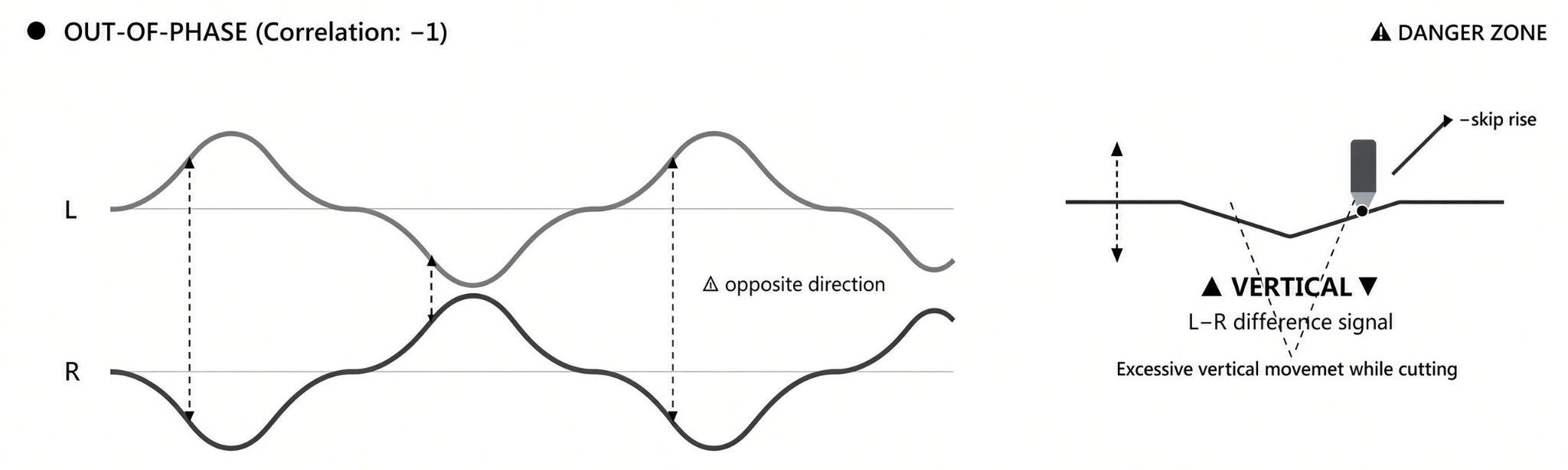
- Out-of-phase or excessive L−R signal (the channel difference). Phase differences between left and right force the cutter to move vertically (up and down). If those motions are not limited, the cutter can dig too deep and damage the aluminium substrate of the lacquer, or rise too high and leave a groove so shallow that the stylus simply jumps out on playback.
Low frequencies in stereo demand a large vertical stylus motion, because groove depth changes sharply. That complex groove geometry can easily make the stylus skip. To avoid it, all low frequencies below 100 Hz should be panned strictly to the centre, not spread across the stereo image.
Out-of-phase material creates a different problem: mutual cancellation of frequencies that the cutting head simply cannot cut into the lacquer. It can seem that the sound gets bigger when drum hits are delayed by a few milliseconds to widen the phase. In practice that out-of-phase material — especially in the sub-bass — makes the cutting head try to move in opposite directions at once, and the cut is ruined. The groove breaks up and the stylus starts to skip. To avoid this completely, keep everything below 300 Hz in absolute phase (mono).
Phase correlation when cutting vinyl lacquers
In vinyl cutting (lacquers/acetates) there is no fixed percentage allowance for an out-of-phase signal. The amount of vertical modulation (the difference signal L − R) is limited not by a percentage, but by the physical geometry of the groove.
Why it matters
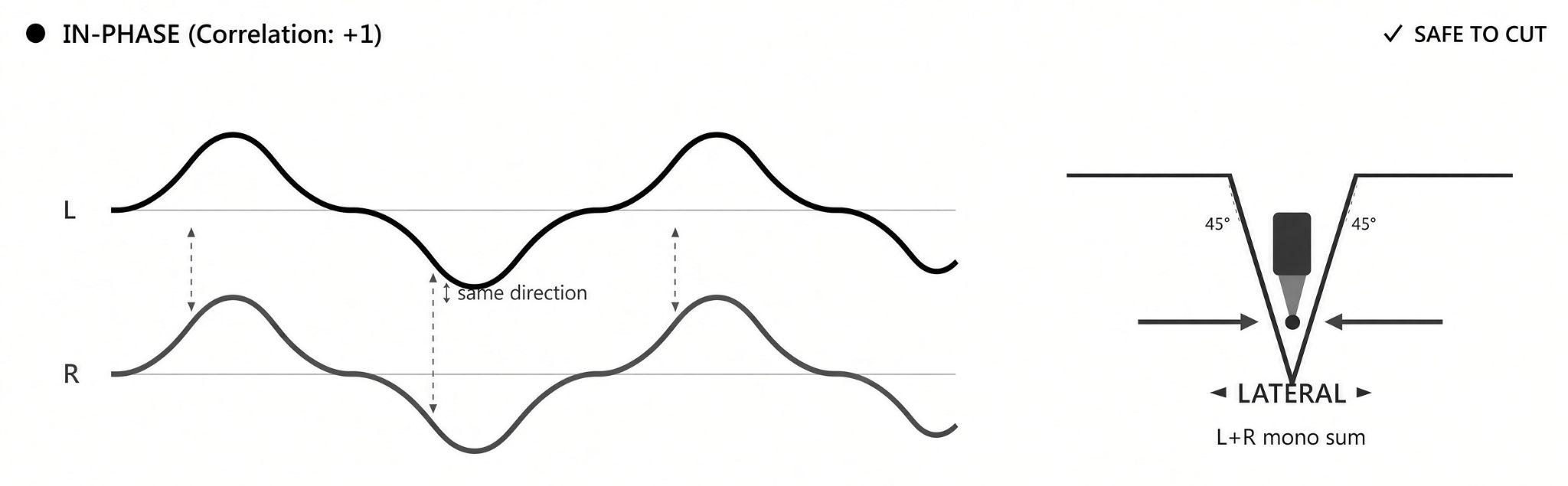
- How it is encoded: in a stereo cut, horizontal cutter motion (the sum L + R) forms the mono component, while vertical motion (the difference L − R) carries the spatial, out-of-phase information.
- Physical risks: excessive vertical modulation makes the groove too shallow (narrow), or lifts the cutter clear of the surface. On playback the stylus will jump out of the groove (a dropout) or damage its walls.
The safety rule
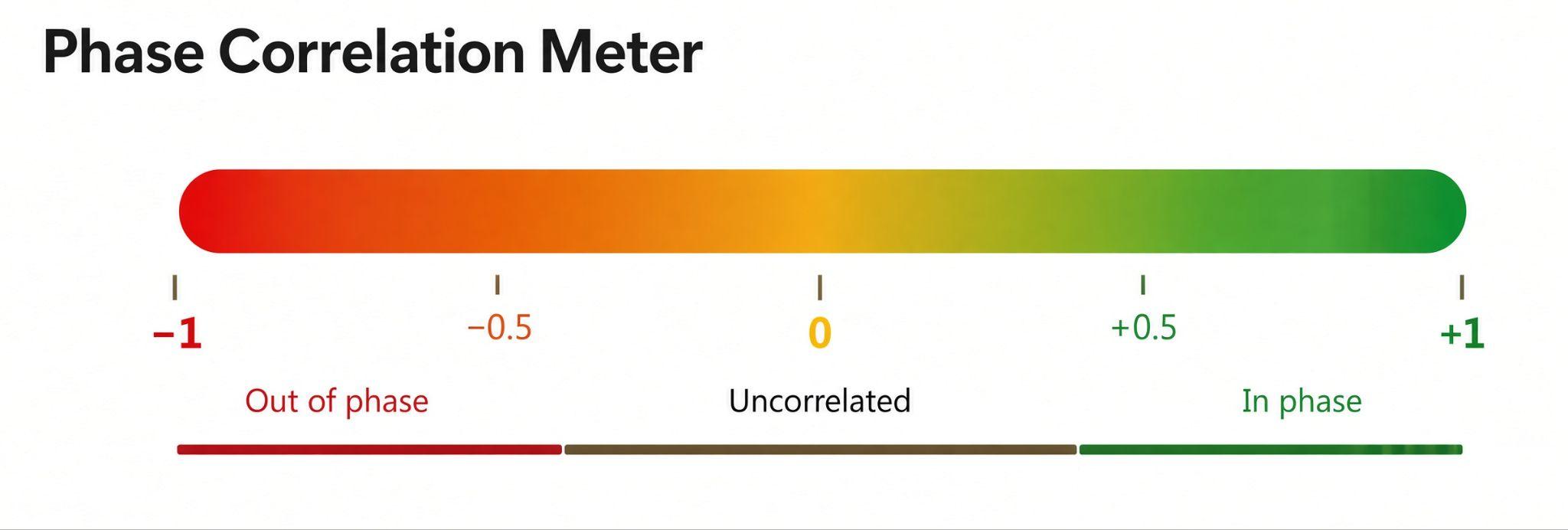
Out-of-phase information must not exceed the allowed limits of cutting depth. Goniometers and phase correlators are used to watch it: the indicator must not fall into the zone from 0 to −1 (where −1 is full opposition).
The technical solution
To protect the lacquer in mastering, an elliptical equaliser (EE) or a vertical limiter is used. They sum the low frequencies (usually below 150–300 Hz) to mono. That removes the dangerous low-frequency vertical motion, keeping groove depth stable and the path safe for the stylus.
The engineer who cuts the master knows these problems and has equipment for them when they appear: steep filters for extreme lows and highs, for example. Low-frequency filters let the engineer keep cutter velocity within acceptable limits. The lathe’s electronics rack also contains acceleration limiters or de-essers, which limit the acceleration of the cutting stylus.